Bonus Episode 1 — Investment Scams: The Red Flags
Duration: 14:21 minutes
Everything you built can be undone in a single moment of misplaced trust. This episode is your armour.
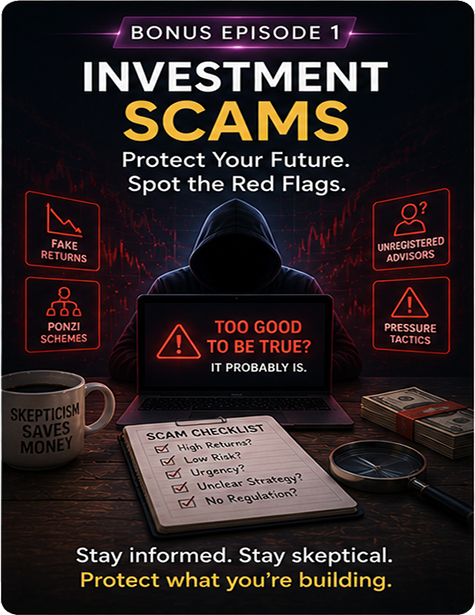
Episode Overview
Duration: 14:21 minutes
This is a bonus episode. It sits outside the series — but it is not optional. Everything we have built together — the time, the compounding, the platform, the tax wrapper — can be undone in a single moment of misplaced trust. In this episode, I walk through how investment scams actually work: the mechanics, the psychology, and two real cases from the US and Europe. Then I give you the red flags, what to do if you are targeted, and why reporting matters more than most people realise.
What You'll Learn
- How big investment fraud really is — the 2024 and 2025 data from the FBI, FTC and Europol
- The mechanics of how these scams operate, step by step
- Two real cases — one from the US, one from Europe — and what made them so effective
- The seven red flags every parent investor must recognise immediately
- Exactly what to do if you think you have been targeted
- Why reporting matters — and why silence is what lets these networks grow
Key Takeaways
No investment guarantees returns
None. If someone promises guaranteed, risk-free returns at any percentage, that is not an investment. Walk away immediately.
Verify the regulator first
Every legitimate platform is registered with a financial authority. Search the official register. If it is not there, do not proceed — for any reason.
Sophistication is not a shield
Victims are doctors, engineers, accountants. Motivated people trying to do the right thing. Awareness is your only real protection.
Episode Summary (click to expand)
An overview of what’s covered in this episode.
This episode exists because everything we have built together can be undone in a single moment of misplaced trust. In 2024, investment fraud was the single most reported category of cyber crime in the United States — nearly 48,000 complaints and $6.5 billion in losses. In Europe, Europol has identified investment fraud as one of the most prolific online crime threats on the continent. In 2025, investment group scam complaints increased by 300% in a single year. This has become an industry.
How These Scams Work
It almost always starts small — an ad on Instagram, a message on WhatsApp, a post in a Facebook group. You are guided to a professional-looking website with charts, dashboards and account balances. You are assigned an account manager who calls you by name, speaks your language, and congratulates you as your balance grows. Except the profits are fiction. The platform is fake. When you try to withdraw, the friction begins — fees, minimum balances, silence. Then the website disappears. I walk through two real cases: a Michigan resident who lost $700,000 through a fake platform promoted by AI-generated Elon Musk ads, and a criminal network in Europe operating professional call centres across six countries that defrauded victims of 50 million euros before being dismantled in April 2026.
The Seven Red Flags
Guaranteed returns — no legitimate investment guarantees anything. Pressure to act quickly — real opportunities do not expire in 12 hours. Requests for secrecy — any platform asking you to keep it from your bank or advisor is a scam. Unverifiable registration — check the official regulator register before anything else. Deepfake celebrity endorsements — AI-generated video of public figures promoting platforms increased 900% between 2023 and 2025. Social media investment groups on WhatsApp or Telegram — these are coordinated fraud operations. Unusual payment methods — cryptocurrency, gift cards, wire transfers to personal accounts. Legitimate brokers do not ask for these.
What to Do If You Are Targeted
Stop all transfers immediately. Do not pay any fees to release funds — that is part of the scam. Contact your bank and explain what has happened. Report to your financial regulator, the FBI’s Internet Crime Complaint Centre, or the FTC. Do not engage with anyone who contacts you afterwards offering to recover your funds. And tell someone — the shame of being scammed keeps people silent, and silence is what lets these networks operate at scale.
Listen to the full episode to hear both real cases in detail, the complete breakdown of every red flag, and the exact steps to take if you think you have been targeted.